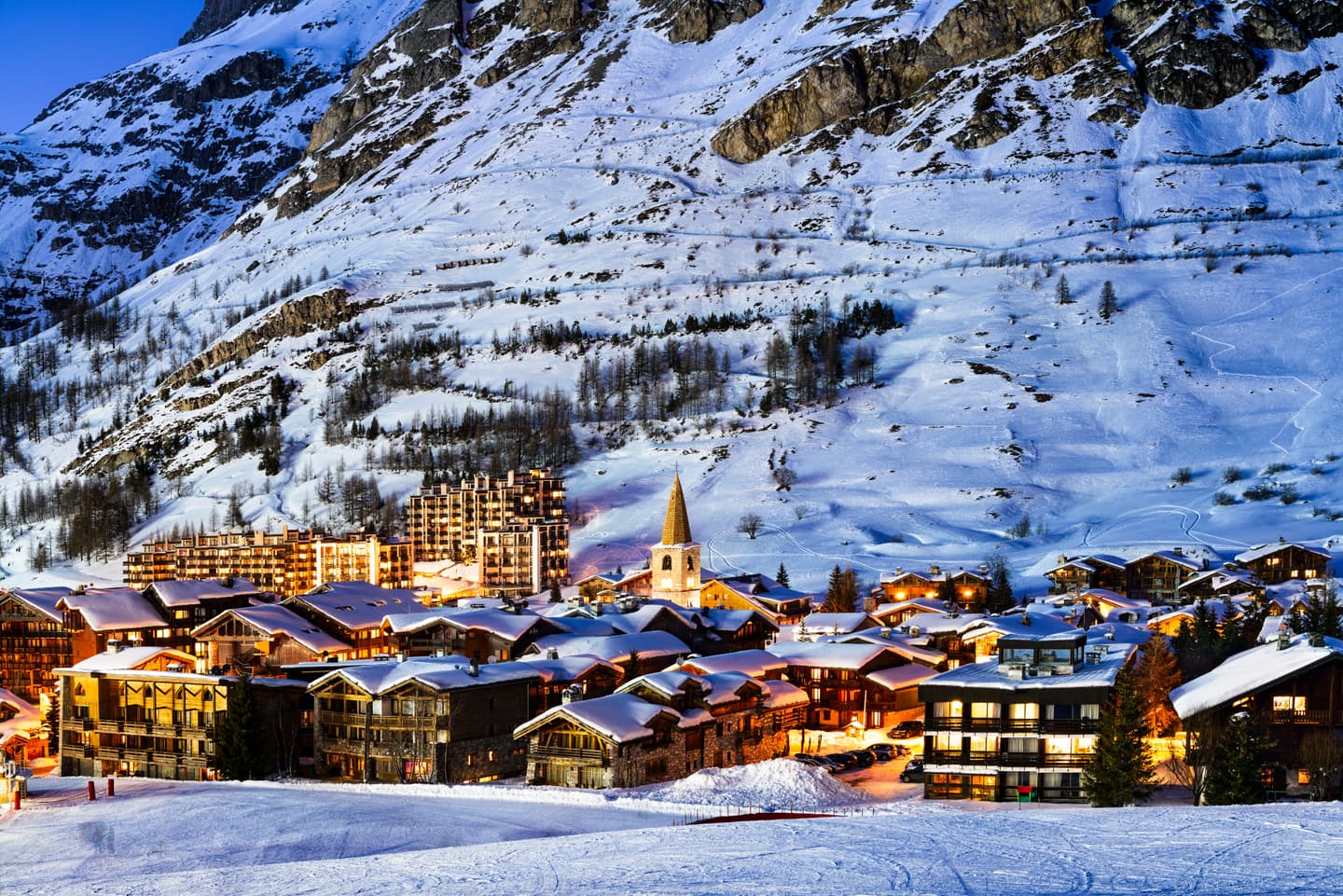
The village runs along the valley floor for about three kilometres, and where you sleep makes a difference. One end puts you on a World Cup piste and a 25 minute walk from dinner. The other end puts you in cobbled streets where the old families still live.
In this article we will explain you how Val d'Isère is laid out, what the skiing looks like, and the two practical things that catch people out: parking, and lift passes.
The four parts of the village
Val d'Isère is not one place but four, strung along the same road, and they suit different weeks.
La Daille. The lowest of the four, at the Bourg-Saint-Maurice end. The Funival funicular goes up from here, and the World Cup downhill finishes here, which tells you what the terrain above is like: steep, fast, and properly good. Watch out for: the walk into the centre, which is around 25 minutes. The free bus exists for exactly this.
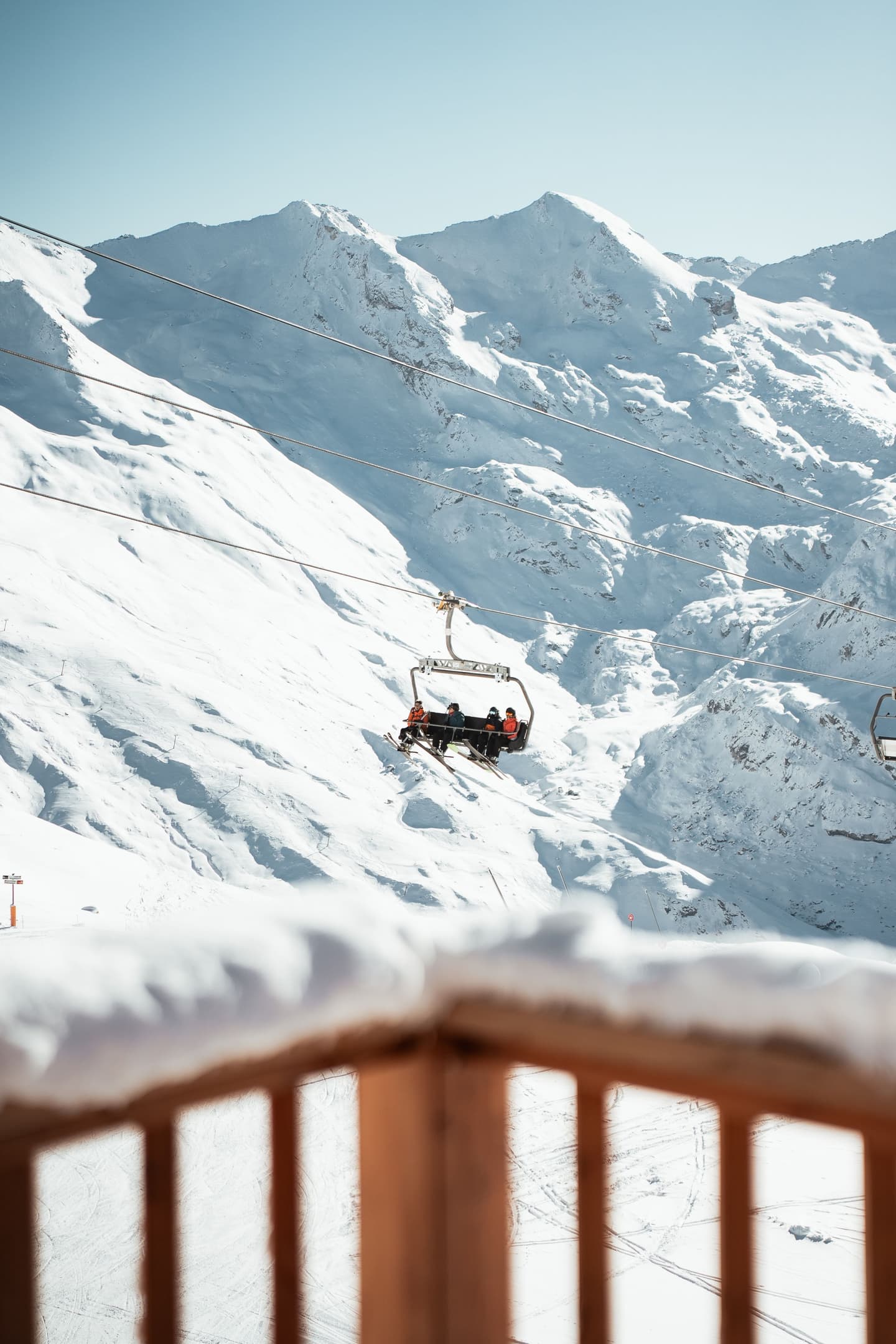
The centre. Shops, restaurants, bars, the tourist office, and the two chairlifts most people use, the Solaise Express and the Bellevarde Express. If your group wants to walk everywhere and argue about dinner on the way, base yourself here.
Le Laisinant. A quieter hamlet a little past the centre. You can ski back down to it off the Solaise sector at the end of the day and catch the bus from the main road. About 15 minutes on foot from the restaurants and bars, which is either a pleasant walk or a nuisance depending on the weather and the hour.
Le Fornet. The highest and the oldest feeling, up the valley towards the glacier. The glacier cable car goes from here, the Arolay sits below it, and the streets are narrow, cobbled and lived in. A lot of the old Val d'Isère families are still here.
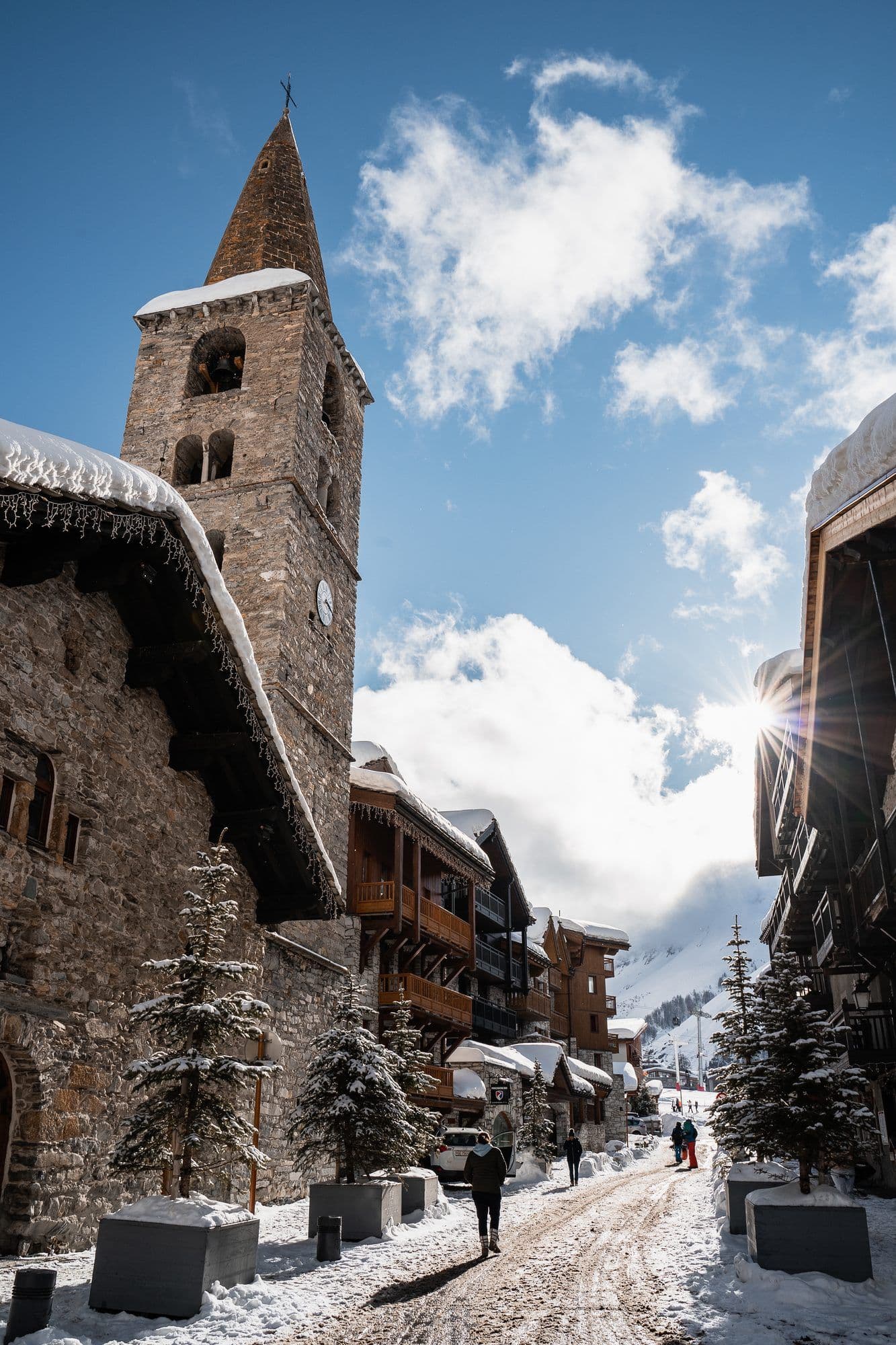
The old village around the Church is the prettiest part of the whole valley: stone houses, small snow-filled streets, and a high street running down from the Church with most of what you need on it. A free bus runs through the village from early morning until late evening, which softens the difference between the four.
The skiing above it
The village sits at 1,850 metres, and the linked pistes above it climb to around 3,450 metres on the Grande Motte glacier. Snow that falls high tends to stay, and the season runs late.
The pistes link straight into Tignes across the top, giving roughly 300 kilometres of marked runs on one pass, with a long tail of off-piste beyond it. The spread is broad: wide greens and blues low down, reds through the middle, and a handful of seriously steep blacks.
For beginners. The reputation that Val d'Isère is for experts only is out of date. There are free nursery lifts in the village, and the gentle terrain on Solaise is where most people go next, with easy runs, long views and mountain restaurants to sit in while faster friends do a lap.
For everyone else. The Bellevarde and Solaise sectors carry most of the traffic, La Daille has the steep stuff, and Le Fornet opens the glacier. There is also cross-country in the Manchet valley, and skate skiing, which is hard and worth learning. Altitude Biathlon runs the Nordic side if you want to try shooting between laps, and hitting a target with your heart rate up is harder than the biathletes make it look.
Good to know: lift and piste figures get quoted differently depending on who is counting and whether Tignes is included. If a number matters to your booking, check the current one with the lift company, or ask us.
Lessons and kit
Val d'Isère is unusually well served by English-speaking instructors, useful if you would rather not learn in French.
Ski schools. The ESF is the big French school, with group and private lessons at every level from the village. Supreme Ski runs small English-speaking groups that gather at the Solaise gondola. TDC, the Development Centre, does small groups and privates including off-piste. Mountain Masters specialises in private tuition and off-piste guiding with English instructors.
Independent instructors. Worth knowing about if you want the same person all week. Clare Angus is a BASI Level 4 instructor with full French equivalence, based here since 2006, and coaches privately. Clare Burns was the first American woman to earn the top French qualification, the Moniteur National, and does video feedback and race training alongside off-piste. Valérie Goin has taught here for around thirty years, on and off piste.
Ski hire. Snowberry has two shops, the original slope-side one at Rond Point and a street-side location, both with storage and pickup so the skis stay in the village overnight.
Good to know: the good instructors are worth booking before anything else, since they are committed for Christmas, February half term and Easter months ahead, and by January it will not be possible to book one.
Lift passes
One pass covers the whole linked area, Val d'Isère and Tignes together, so there is no decision to make about scope. A photo of your pass on day one is worth taking, since a lost pass is quicker to replace with the number to hand. Young children and the oldest visitors ski free, with reduced rates for children, teenagers and seniors in defined bands. Longer passes include free days, and six-day passes and up also unlock reduced rates at nearby La Rosière and Sainte-Foy, a good excuse for a day out of the valley. Passes of a week or so need no photograph, which saves a small administrative step. Carré Neige insurance is sold by the day alongside the pass and covers search and rescue, medical transport and repatriation, worth having on a mountain this size. Group rates exist for a mix of adults and children on longer passes.
We can organise passes before you arrive so nobody spends the first morning in a queue. All we need are names and dates of birth for anyone under 18.
Parking
There is no free parking in Val d'Isère, so where the car goes is worth deciding before you arrive.
Seven public car parks serve the village, spread between the centre, Face de Bellevarde, La Daille, Le Crêt, Plaine de la Daille, Le Laisinant and Manchet. Underground and covered parks cost more than the open-air ones, and the open-air ones are further out.
The thing that catches people out is height, since the underground parks have clearance limits running from roughly 1.90 metres to 2.10 metres depending on which one you pick, and a van, or an ordinary car with a roof box on, will not fit into all of them. Measuring before you leave home and booking the space in advance is a lot easier than finding out at the barrier on a Saturday.
Electric charging is available in several of the car parks, concentrated in the central one, on slow terminals with a cap on how long you can stay plugged in.
When to come
The season runs late November to early May, and the character of the week changes a lot across it.
Early season is quiet with fresh snow. Christmas and New Year are close to full. Mid-January to mid-February is the sweet spot for anyone who can travel then: quiet slopes, real choice of houses. The UK and European half terms fill the second half of February. March is one of the best months here, quieter than February with noticeably longer days. Easter moves around and takes two or three busy weeks with it.
And because the village is high, the last few weeks are not a write-off. Skiing after Easter is a real thing in Val d'Isère, and it belongs to people who care more about the snow than the scene.
For a proper month-by-month read, including what the snow actually does, see our guide to the best time to ski in Val d'Isère.
Which end should you stay in?
Centre if you want to walk to dinner. Le Laisinant or Le Fornet if you want quiet and do not mind the bus. La Daille if the skiing matters more than the evening, and a ski-in, ski-out home settles the question either way, since the day starts and ends on the snow. Old village if you want the stone streets and the Church at the end of them.
Discover Val d'Isère with One of a Kind Travel
Which end of the village you sleep in shapes the week, so it is worth choosing deliberately. Our chalets and apartments in Val d'Isère are spread across the centre, the quieter hamlets and the ski-front, with the walk to the lifts and the bus stop noted on every one.