
Flamingos are not on Ibiza all year. They stop at the Ses Salines salt pans on migration, which gives you two windows: roughly late March to May on the way north, and late August into October on the way back. The autumn one is usually the better of the two, and a few birds overwinter in some years.
That is the fact the postcards leave out, and it is the one worth knowing before you drive down there in July expecting a field of pink. The pans themselves are worth the trip in any month; the birds are a seasonal bonus on top.
What the salt flats are
The pans sit behind the beaches at the southern tip of the island, and they are still a working saltworks. Sea water is let into shallow basins and left to evaporate through the summer, and what is left is harvested and sold as Sal de Ibiza. The industry is the oldest on the island by a long way; the Phoenicians were doing the same thing here.
The whole area has been the Ses Salines Natural Park since 1995. It covers around 15,000 hectares, most of which is sea, and it runs south across the channel to take in Formentera's salt flats as well. More than 210 bird species have been recorded in it.
Where to stand
The pans are on the road between San Jordi and Ses Salines beach, and there are laybys along it where you can pull in. You cannot walk into the basins themselves, which are fenced and off limits, but there are paths around the perimeter and the birds are often close to the edge.
The best of the water for birds is the stretch towards Es Codolar and behind Es Cavallet. Early morning and the last hour of light are when the birds feed and when the water goes still enough to reflect, and the middle of the day is flat and hot and largely empty.
Bring something to see with. The birds are often two or three hundred metres out, which is close enough to watch and too far to photograph on a phone.
What else is out there
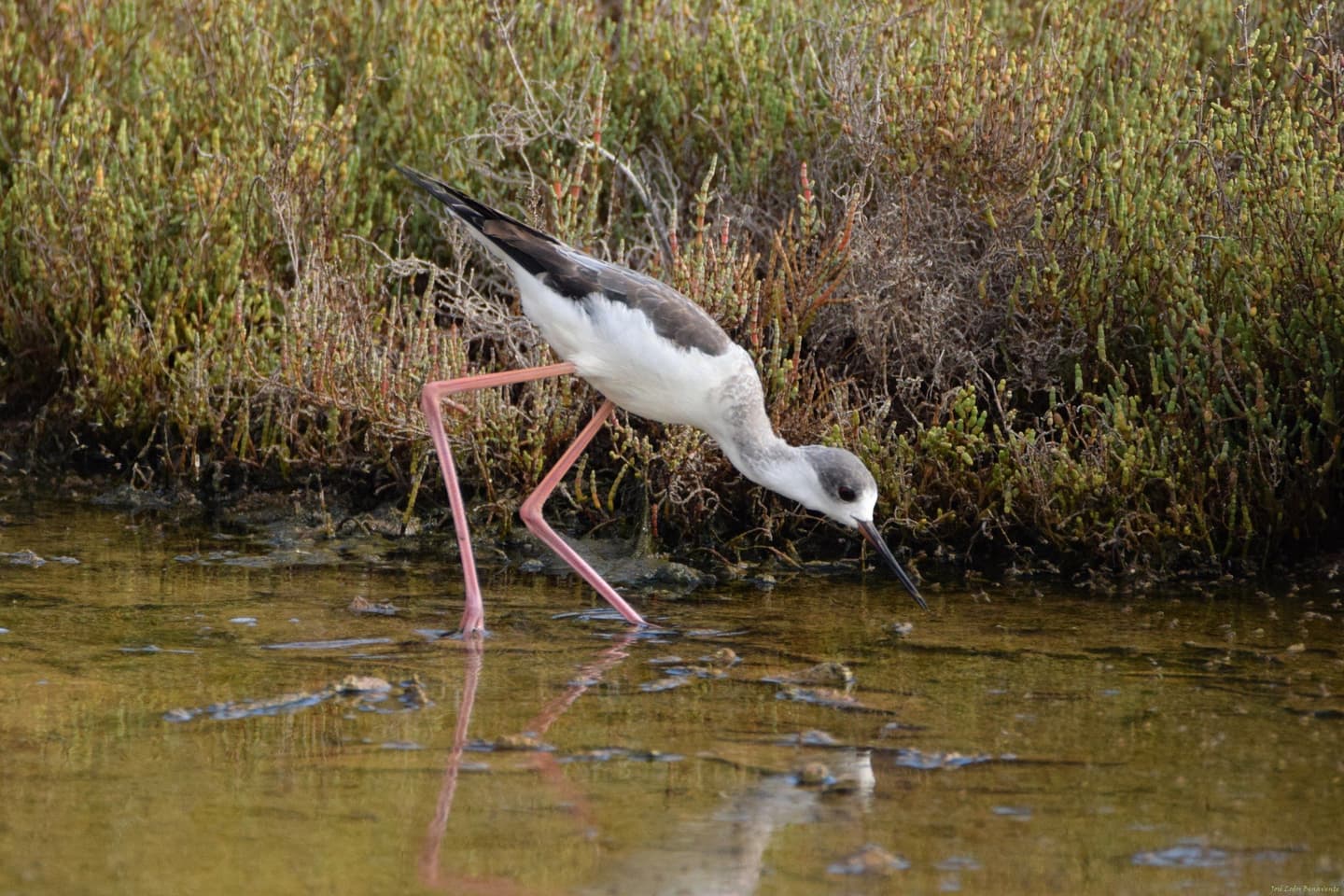
Flamingos get the attention, but the pans hold black-winged stilts, avocets, Kentish plovers and grey herons through much of the year, and the reed beds behind them are noisy at dusk. In the dunes between the pans and the sea there are junipers and Ibizan sabina pines growing out of the sand, and a path runs through them from the car park to the water.
The salt-workers' cottages along the road and the old church at San Francisco de s'Estany are part of the same landscape, and the church is worth the two minutes it takes to look at.
Quick answers
When can you see flamingos in Ibiza? Two windows: roughly late March to May, and late August to October. The autumn passage is normally the larger.
Are they there in July and August? Usually not in numbers. High summer is the gap between the two migrations.
Where is the best place to see them? The laybys along the Ses Salines road, and the water behind Es Cavallet and towards Es Codolar.
What time of day? Early morning or the hour before sunset.
Can you walk into the salt pans? No. The basins are closed. The perimeter paths and the road are as close as you get, and that is close enough.
Is it free? Yes, though the beach car parks at the end of the road charge in season.
Is it good with children? For an hour, yes, especially combined with the beach at the end of the road. It is flat, easy walking, and there is no shade to speak of.
Fitting it into a day
The pans are ten minutes from the airport and fifteen from Ibiza Town, and the road through them ends at two of the best beaches on the island, so this is rarely a trip on its own. The version that works is the beach in the middle of the day and the pans on the way back out, when the light has dropped and the birds have come in to feed.
If you are timing a trip around the migration rather than the weather, our guide to Ibiza weather by month covers what else those two windows give you. Our advisors can also tell you what the pans looked like last week, which is more use than an average.