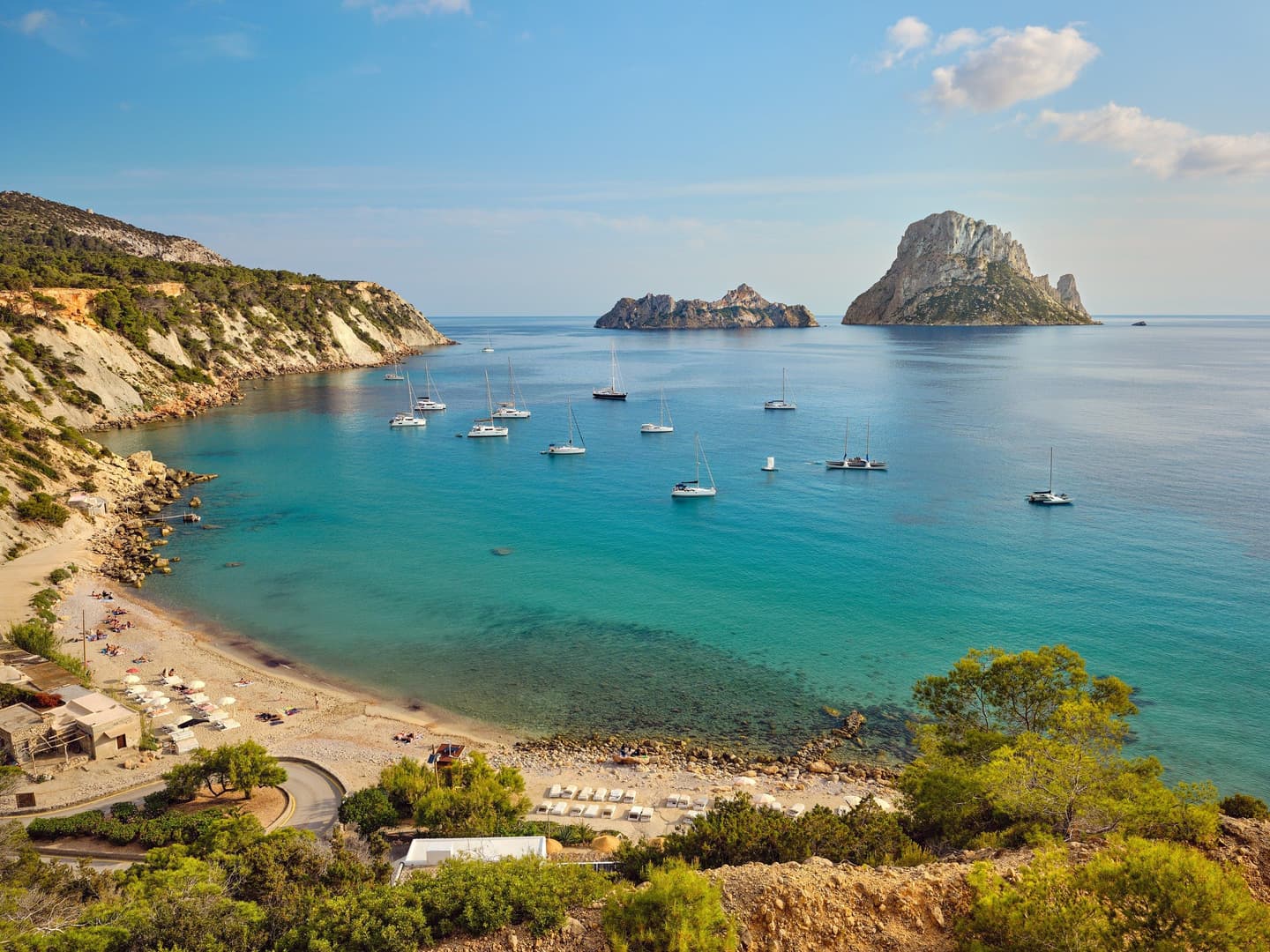
Ibiza is small enough that 30 to 40 minutes gets you from the quietest village in the north to the busiest beach in the south, so you are not choosing which half of the island to give up. You are choosing what you want on your doorstep, and treating everything else as a drive.
So the five parts below are less about attractions and more about mornings and evenings: where you wake up, where you eat, how far the beach is. The sights that are worth building a whole day around come after, then a month-by-month note, since the island in April and the island in August are two different holidays.
The five parts of the island
The south
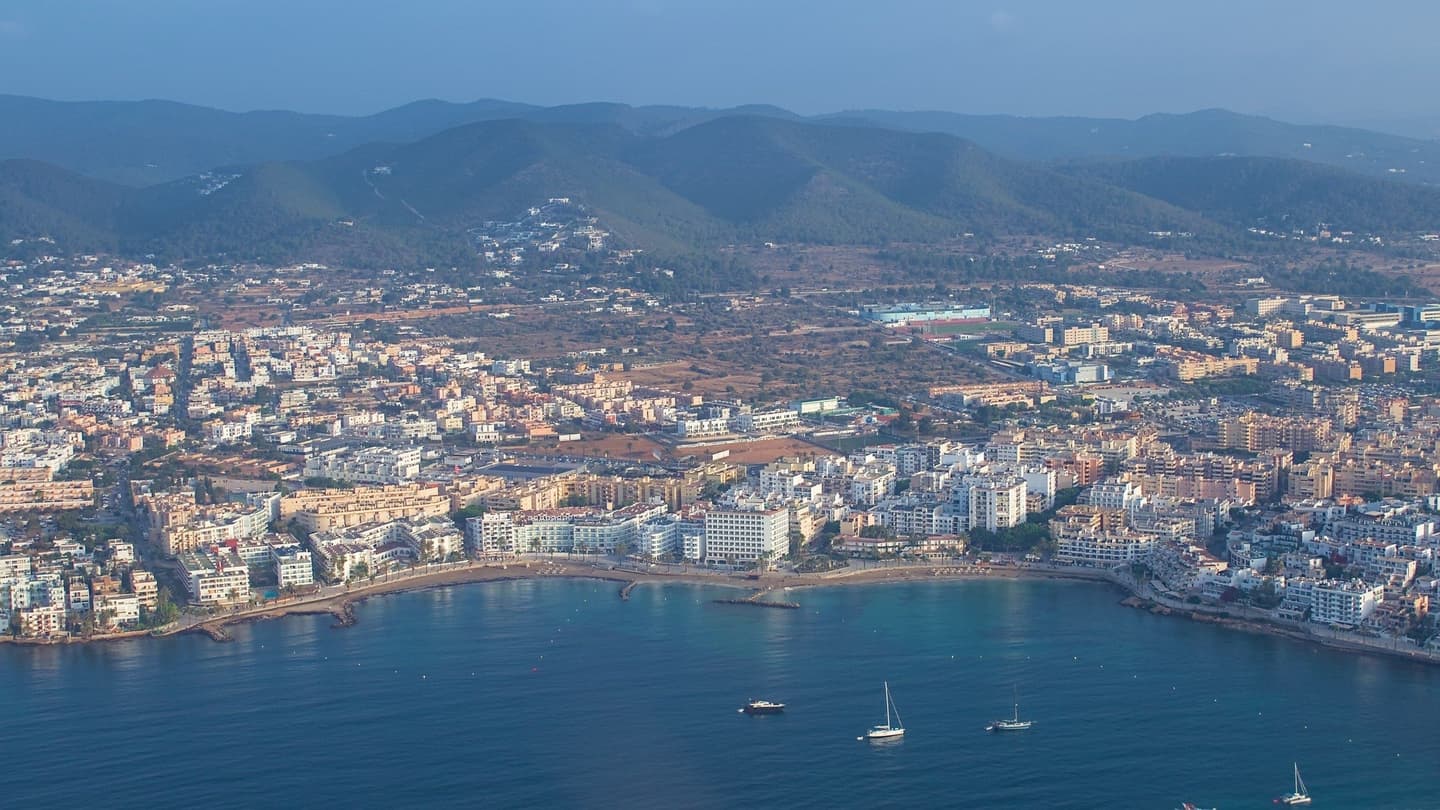
The south holds the beaches most people picture first, Playa d'en Bossa, Figueretes, Es Cavallet and Ses Salines, along with Ushuaïa and Hï on the Platja d'en Bossa strip. Sa Trinxa sits at the far end of Ses Salines, Beso Beach and El Chiringuito are along the same run of sand, and Amante is tucked into the cliff at Sol d'en Serra a little further round. Behind the beaches you get Talamanca, Jesús, Cala Llonga and Roca Llisa, which has the island's golf course.
This is the shortest hop from the airport and from Ibiza Town, and villa prices in the south sit above the north and east, which is worth knowing before you compare like for like.
The west
The west coast is where the island faces the sunset, so the beach clubs and the evening crowd concentrate here. The bays run Cala Comte, Cala Bassa, Cala Tarida, Cala Vadella, Cala Codolar, Cala Salada and Cala d'Hort, the last of which looks straight out at Es Vedrà. Sunset Ashram sits above Cala Comte and Cotton Beach Club above Cala Tarida.
San Jose is the main village, and the hillsides above it, Es Cubells and Vista Alegre, look across open water towards the Spanish mainland.
The north
The north is the countryside half of the island: San Juan, San Miguel, Santa Agnès, San Mateo and Portinatx, with Benirrás and Cala d'en Serra for swimming. The kitchens here are small and good, among them The Giri Café in San Juan, Los Enamorados up at Portinatx, and Elements down on the sand at Benirrás. Atzaró sits on the San Juan road in an old orange grove.
The distances are the thing to hold onto: about 45 minutes to the airport, 30 to 40 minutes to the clubs, and only 15 to 20 minutes to Santa Eulalia for a supermarket and a proper dinner. The north is quiet by choice, not by isolation.
The east
The east is the calmest coast, and the one families tend to settle on: Cala Llenya, Cala Nova, Cala San Vicente and Aigües Blanques, which has a clay bank people use as a mud bath and a long tradition of clothes-optional bathing. Aiyanna sits above Cala Nova. Santa Eulalia anchors the whole coast with a marina and a restaurant street on Carrer de San Vicente, and San Carlos is the village behind it.
Fincas are the traditional house type here, and the east tends to price below the south for the same size of home.
The centre
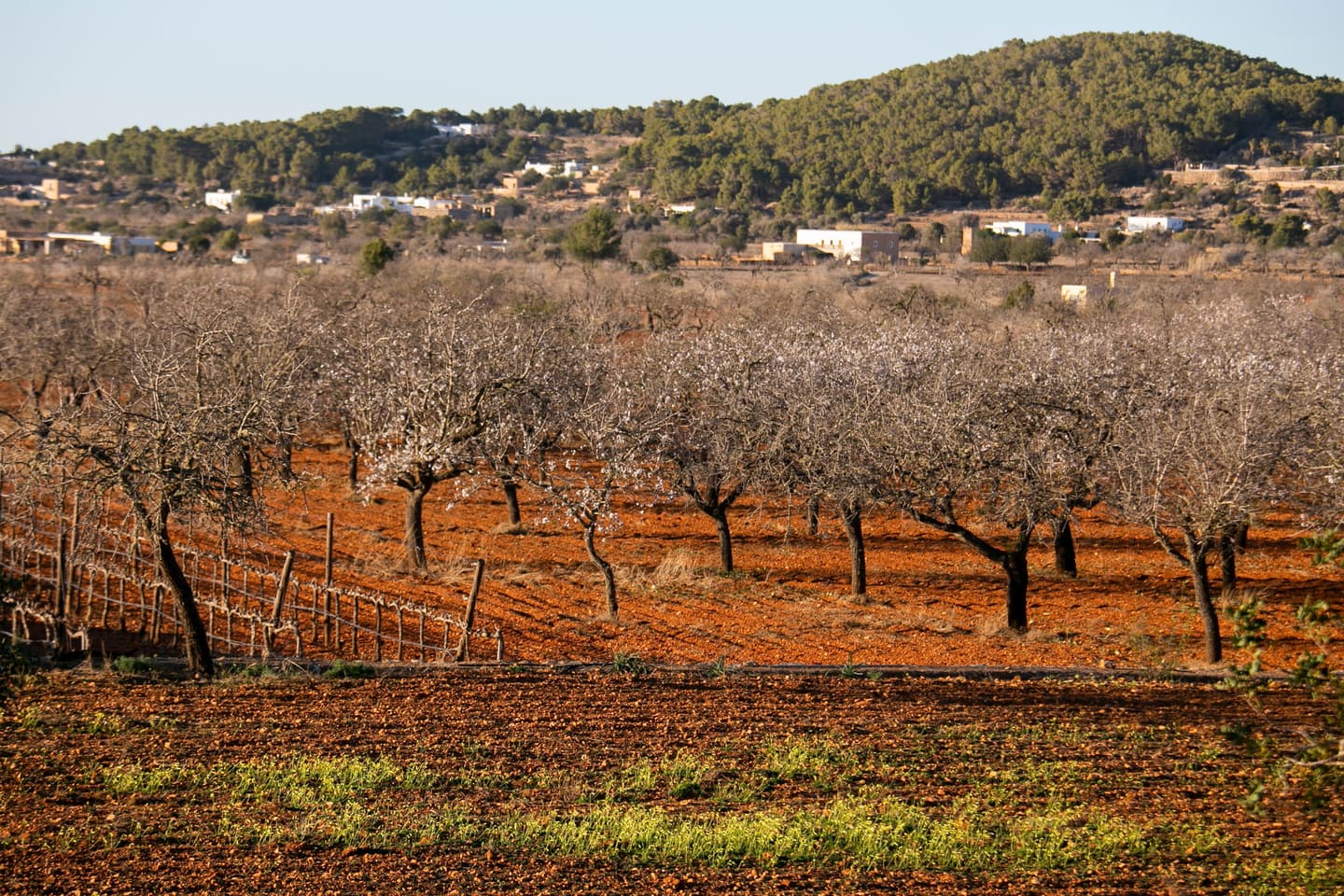
The middle of the island is flat, green and within reach of both coasts, which is why so many houses sit here. Santa Gertrudis is the best known of the villages, with Bar Costa on the square and a run of shops and kitchens around it. San Rafael is a few minutes away and has both Amnesia and UNVRS on its doorstep, so the centre is closer to the club night than its farmland suggests. La Paloma, in San Lorenzo, puts its tables out under fruit trees.
If you cannot decide between the coasts, this is the answer. Our advisors will often point a first-time group at Santa Gertrudis for exactly that reason.
The sights worth building a day around
The hippie markets. Punta Arabí at Es Canar is the original and the biggest, and it runs on Wednesdays from April to October, roughly 10:00 to 19:00. Las Dalias at San Carlos is the other one, on Saturdays all year, with Sunday openings in the shoulder months and a night market on Monday, Tuesday and Sunday evenings through the summer. Good for: a half day with something to eat at the end of it. Good to know: the two are different markets on different days, so a Saturday plan and a Wednesday plan are not interchangeable.
Ses Salines salt flats. The salt pans behind the beach are a nature park and part of the island's UNESCO listing, and salt is still harvested here and sold as Sal de Ibiza. Expect: flat water, low light and birds rather than a view. Good to know: flamingos use the pans on migration, so the best chances fall between July and October, with a second window in late winter and spring. They are not there year round.
Es Vedrà. The rock off the south-west coast, seen from the plateau above Cala d'Hort. A rough track takes you to a parking area, then it is a short walk to the viewpoint, with paths carrying on to an old watchtower and to the caves that hippies decorated and left a logbook in. Good for: sunset, and the one photograph everyone takes home.
Time and Space at Cala Llentia. Thirteen dark stone columns standing in an oval on open ground above the sea, by the Australian artist Andrew Rogers and commissioned by Guy Laliberté of Cirque du Soleil. The tallest lines up with the sunset at the winter solstice. It gets called the Ibiza Stonehenge, which undersells how odd and quiet it is in person. Good to know: it stands on publicly reachable land, with a walk in from the parking area.
Cova de Can Marçà. A cave in the cliff at Port de San Miguel, open all year, with guided tours running through the day in several languages, a ten metre waterfall with a light and sound show, and smugglers' markings still visible on the walls. The walkway out gives you the sea from inside the cliff. Good for: the wet afternoon, or the day everyone has had enough sun.
Es Broll de Buscastell. A green valley between San Mateo and Santa Agnès with irrigation channels, small orchards, old bridges and a restored mill more than two centuries old. Expect: more water in spring than in high summer, and almost nobody there.
Dalt Vila and Puig des Molins. The walled upper town in Ibiza Town is UNESCO listed, and the cathedral at the top is worth the climb for the harbour view. Just outside the walls, Puig des Molins is a Carthaginian burial ground covering some 10,000 square metres, with a museum attached and a settlement history going back to around 600 BC. Good for: a late afternoon and an early evening, in one walk.
Formentera. The neighbouring island, reached by ferry from Ibiza Town or Santa Eulalia, with sand dunes, long shallow water and caves you can only get to by boat. Good to know: it is a full day rather than a morning, and it costs more than Ibiza once you are there.
Benirrás on a Sunday. Drummers gather on the beach in the north through the summer and play towards the sunset. It is the one piece of the island's 1960s reputation still running on its own steam.
What to do, month by month
April. Days sit around 20°C and the countryside is under wild flowers. Dalt Vila, the walking routes above San Jose and Santa Eulalia, and the two hippie markets are all in play, and the beaches are empty. Swimming is for the determined.
May. The best month for walking or cycling, and the point where Cala d'Hort and Cala Salada can still be had without a crowd. The clubs open through late April and May, so a May week can have both a quiet beach and an opening night in it.
June to August. Peak everything: warmest water, longest days, every beach club and every club running. July is the driest month of the year, and the middle of the day in August is for shade rather than sightseeing.
September. Still summer in the water, which stays around 24°C, with the crowds thinning after the first week. The best all-round month if you want the sea and the space.
October. The closing parties fall in the first half of the month and the big clubs shut behind them. What is left is the better half of the island for walking, cycling, kayaking and diving, plus the museums and villages without the queues. It is also the wettest month, so a week here needs a plan B in it.
November to March. Almond blossom fills the fields around Santa Agnès in late January and February, the markets at Las Dalias, San Juan and Forada keep going all winter, and the walking is at its best. The coast is quiet and much of the beach infrastructure is closed.
Quick answers
Is Ibiza worth visiting if you do not go clubbing? Yes. The clubs occupy roughly May to early October and a few square kilometres of the south. The markets, the salt flats, the caves, the walled town and the north coast are all there independently of them.
How long do you need? A week covers all five parts of the island comfortably, with a day for Formentera.
Do you need a car? For anything outside your own village, yes. The bus network links the main towns but not the small bays, and the interesting drives are short.
What is the top thing to see? Es Vedrà from the Cala d'Hort side, then the walled town of Dalt Vila.
When is the best month? May, June and September, for weather without the peak crowds.
Which part of the island is quietest? The north, followed by the east coast.